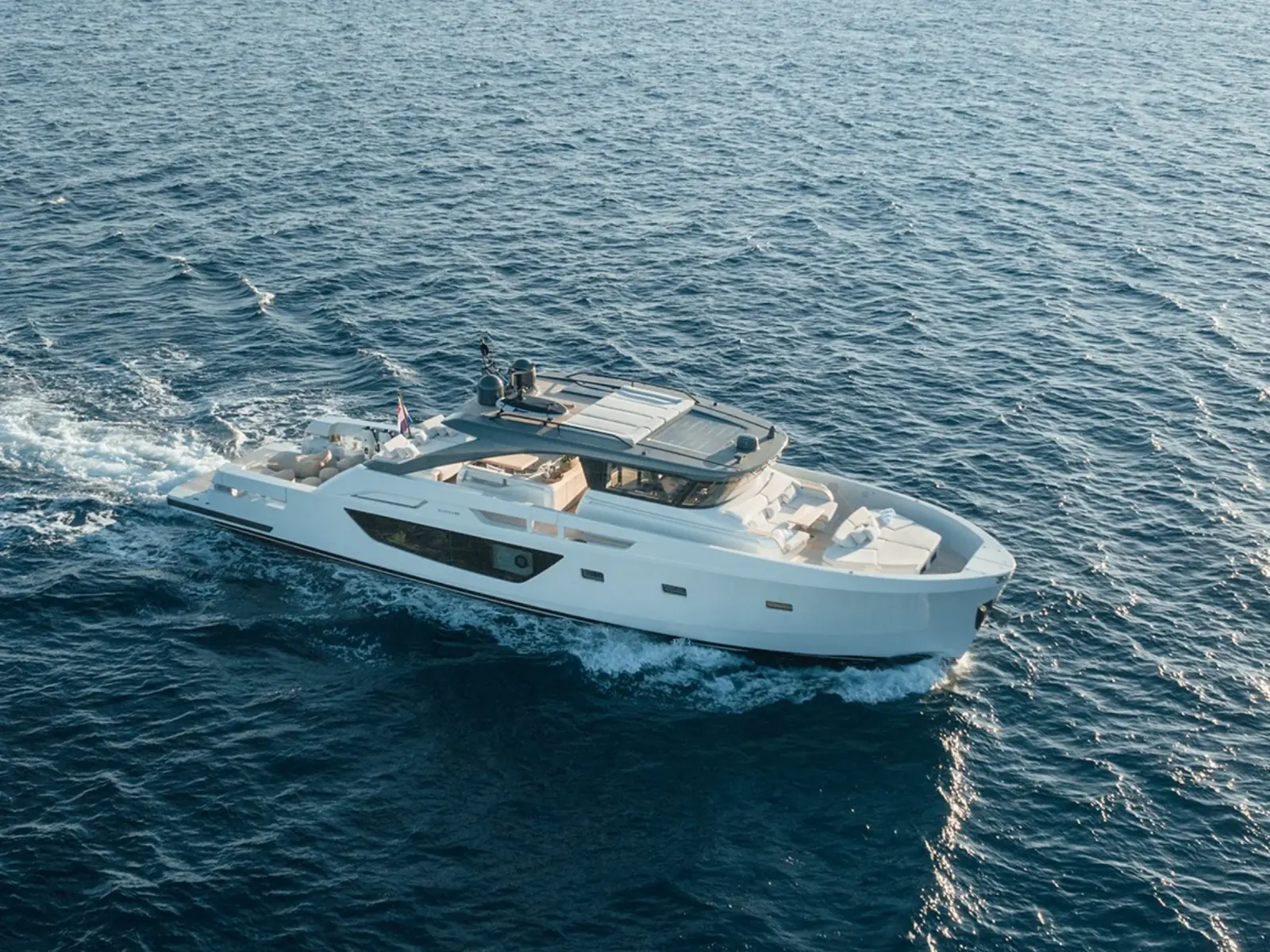
Two yachts of the same length, with the same engines, can need very different servicing. What changes is how the power gets from the engine to the water. In the Bluebnc Yachting managed fleet that we look after in Mallorca, five different drive arrangements appear across eleven builders, which makes it a useful way to explain the differences.
This guide covers what each type is, which parts wear, and what we look at first. The model examples come from the builders' own published specifications; the drive fitted to any individual yacht is always confirmed on board.
At a glance
| Drive | How it works | Fleet examples | What needs most attention |
|---|---|---|---|
| Conventional shafts | Engine and gearbox drive a shaft through the hull to a fixed propeller; rudders steer | Sunseeker 76 and 95, Azimut Grande 32 Metri | Alignment, shaft seals, cutless bearings, couplings, rudders |
| IPS pods | Steerable pods under the hull with forward-facing twin propellers, controlled through EVC | Bluegame BG54 and BG74, Prestige 680, Fjord 52 and 48 Open | Pod oil, seals, anodes, propellers, software and joystick |
| Surface drives | Propellers run half out of the water at speed, with hydraulic trim and steering | Canados Gladiator 631 (JDM 30) | Trim hydraulics, transom seals, propellers, rudders |
| Sterndrives | Engine inboard, drive leg outside the transom that steers and trims | Windy 39 Camira (Volvo Penta Aquamatic) | Bellows, gear oil, anodes, trim, propellers |
| V-drive | Engine mounted aft facing forward; a V-drive gearbox turns the power back to a shaft | Sirena 64, Riva Rivarama | V-drive gearbox, coupling, shaft alignment, access |
Conventional shafts
This is the traditional layout and still the standard on larger yachts. Sunseeker publishes shaft propulsion for both the 76 Yacht and the 95 Yacht, and Azimut's Grande 32 Metri pairs twin MTU engines with ZF gearboxes and conventional shafts.
The engine, gearbox and shaft must stay in line. Engine mounts settle, hulls flex and couplings wear, and a small misalignment shows up first as vibration at certain rpm, then as wear on the cutless bearing and shaft seal. When we service a shaft installation we:
- measure alignment at the coupling and look at the condition of the engine and gearbox mounts;
- check the shaft seals for leaks and the cutless bearings for play, usually during a haul-out;
- inspect propellers for damage and rudder bearings and steering linkages for wear;
- record vibration under comparable load so the next reading has something to be compared with.
Shaft yachts are the most forgiving of the five, but they need the yacht out of the water for the full job.
IPS pods
Volvo Penta's IPS puts the propellers on steerable pods under the hull, with twin counter-rotating propellers facing forward. Steering, throttle and joystick docking all go through the Electronic Vessel Control (EVC) system. In the fleet, the Bluegame BG54 and BG74, the Prestige 680 and both Fjord models use IPS.
IPS servicing is closer to aircraft maintenance than to traditional shaft work. A lot of it is scheduled by running hours and done to the manufacturer's procedure:
- pod oil and filters, and a look at the oil itself for water or metal;
- seals and boots where the pod passes through the hull;
- anodes and propellers, which see a lot of punishment from lines, debris and sand in shallow anchorages;
- software and diagnostics: EVC stores fault codes and running data, which is the first thing we read on any IPS fault.
Because the pods hang below the hull, anything picked up at anchor goes straight into them. After fouling a line, have the propellers and seals checked before the next long run.
Surface drives
On a surface-drive yacht the propellers sit behind the transom and run half out of the water at speed. The Canados Gladiator 631 is published with JDM 30 Special surface drives (a straight-shaft version is also offered). Surface drives give speed and shallow draft, but they rely on hydraulics for trim and steering.
What we check first:
- trim and steering hydraulics: oil level, leaks, ram seals and the pump;
- transom seals and bearings, where the drive passes through the hull;
- propellers, which are specialised and expensive; damage changes the handling noticeably;
- rudders and steering on installations that use separate rudders.
Sterndrives
A sterndrive keeps the engine inboard and puts a drive leg outside the transom. The leg steers and trims, so there's no separate rudder. The Windy 39 Camira in the fleet runs Volvo Penta D6 engines with Aquamatic sterndrives.
Sterndrives need regular, inexpensive attention, and they suffer quickly when it's skipped:
- bellows (the rubber boots between the leg and the transom) age in the sun and the sea, and a split bellows lets water in;
- gear oil should be checked and changed on schedule; milky oil means water has got past a seal;
- anodes, trim rams and propellers are routine items at each haul-out.
V-drives
A V-drive installation mounts the engine aft, facing forward, and a V-drive gearbox turns the power back towards the stern to a conventional shaft. It frees up space in the middle of the yacht. Sirena publishes V-drive diesel inboards for the 64, and Riva's Rivarama uses a V-drive with shafts and bronze propellers.
The shaft side is serviced as for a conventional installation. The extras are the V-drive gearbox itself, the coupling between engine and gearbox, and alignment, which matters more because the engine and the shaft line meet at an angle. Access is often tighter, so it pays to plan the work.
Why this matters for a booking
When you book a service online, tell us the drive type along with the engine make. It changes which technician we send, what diagnostic equipment they bring and whether the job needs a haul-out. If you're not sure, a photo of the stern and the engine plate is usually enough.
Each builder page lists the published machinery for the yachts in the fleet: start from yacht service by builder. The propulsion and shaft alignment page covers the drive-train work itself, and main engine service covers the engines.