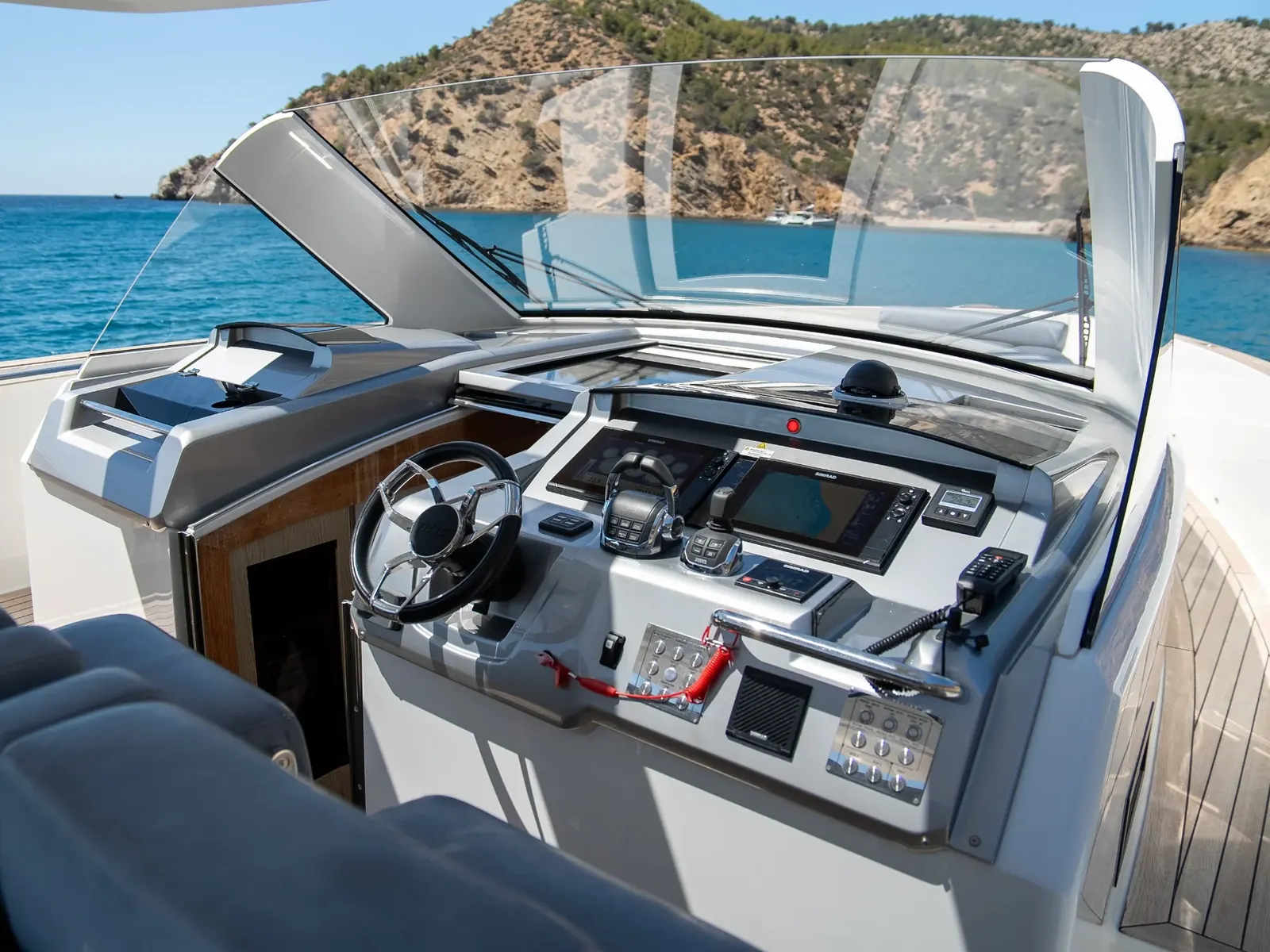
A yacht battery monitor can show a full bank while the batteries still deliver poor runtime. State of charge, battery condition and usable capacity are related, but they are not the same measurement.
This guide explains how to inspect lead-acid banks, interpret monitor data, choose suitable tests for flooded, AGM and gel batteries, and approach replacement without masking a bank-level problem.
State of charge is not battery health
A battery monitor measures voltage and current, then uses those measurements to calculate state of charge. The displayed percentage is not a direct capacity test or state-of-health measurement. A bank can therefore reach a full state-of-charge indication without that display proving how many amp-hours it can deliver under a controlled load.
The calculation also depends on correct shunt wiring. All load negatives and charge-source negatives must connect to the system side of the shunt. Any direct connection to battery negative bypasses the monitor, so the current is not counted and the displayed state of charge can be higher than the actual state.
Review the monitor history rather than relying on the current display alone. Useful records include current, voltage, state of charge, deepest discharge, cycle information and trends. Victron's lead-acid guidance says repeatedly discharging well below 50% state of charge significantly reduces battery life.
Time spent deeply discharged also matters. Victron warns that leaving a lead-acid battery deeply discharged for more than a few days can cause unrecoverable damage. Recharge a low bank promptly rather than assuming that shore-charger float alone will recover it. For vessels spending extended periods idle, the yacht laying-up checklist provides a wider framework for onboard checks.
Inspect the complete bank before testing
Start with a visual inspection of every battery. Damaged cases, acid leakage, swelling or deformation, damaged or heavily corroded terminals and burn marks are fault indicators, not normal signs of ageing.
Record the condition of each unit before resetting alarms or applying charge. Heat should also be logged. If a battery is hot, swollen, leaking or burnt, stop the crew-level check and arrange an engineer's assessment rather than proceeding to an electrical test.
The inspection should also identify the model, age and capacity of every battery in the bank. Victron's multi-battery test procedure specifically asks whether all units match in these respects. Dissimilar batteries make the bank's behaviour and diagnosis less reliable.
Do not treat a clean case and a full monitor display as proof of condition. Visual inspection identifies physical faults, while the monitor reports calculated state of charge. Capacity requires a suitable test when runtime remains in doubt.
Choosing the right battery test
The test must match the battery construction and the question being asked. Open-circuit voltage, specific gravity and controlled discharge testing provide different information. A hand-held conductance result must not be treated as proof of AGM or gel deep-cycle capacity.
| Check or symptom | What it can establish | Limitation | Appropriate action |
|---|---|---|---|
| Monitor shows full charge | Calculated state of charge | Does not directly measure capacity | Review runtime and monitor history |
| Open-circuit voltage | Voltage after an idle period | Charge and discharge must be absent | Leave idle as Trojan specifies |
| Specific gravity | Cell readings in flooded batteries | Not for sealed AGM or gel units | Follow the flooded-cell procedure |
| Hand-held AGM or gel test | Does not establish deep-cycle capacity | Not a controlled capacity test | Arrange controlled charge and discharge |
| Controlled discharge | Calculated amp-hour capacity | Test conditions must follow the manufacturer | Compare with the manufacturer's criterion |
Open-circuit voltage
Trojan says an accurate open-circuit voltage reading requires the battery to remain idle, with no charging or discharging, for at least six hours and preferably 24 hours. A voltage taken while loads or charging sources are active does not meet that procedure.
This reading should be interpreted alongside discharge history and runtime. It does not replace a controlled capacity test when the bank appears charged but performs poorly.
Flooded-cell specific gravity
Specific-gravity testing applies to flooded batteries only. Readings are required from all cells and must be corrected for temperature. Trojan identifies readings below its factory specification of 1.277 ± 0.007 after charge or equalisation as grounds for specialist evaluation or retirement.
Only a trained person wearing suitable protection should follow the battery manufacturer's hydrometer and water-level procedure. Do not open sealed AGM or gel batteries.
AGM and gel capacity testing
Victron states that the capacity of its AGM and gel deep-cycle batteries cannot be established with hand-held battery testers. Its controlled procedure starts with the battery fully charged, applies no more than a C20 DC load and stops the load when voltage falls below 10.8 V. Amp-hour capacity is calculated from current multiplied by the test duration.
Under that cited Victron procedure, calculated capacity of at least 75% of rated capacity passes, while a result below that level classifies the battery as faulty. Keep that threshold tied to the cited procedure. Where another manufacturer provides its own test method and replacement rule, use those instructions instead.
Matching batteries and planning replacement
A replacement decision should consider the whole bank, not only the unit with the lowest reading. Record each battery's model, age and capacity, then check whether the bank is already mixed. This gives the engineer the information needed to interpret uneven behaviour and plan the replacement.
Trojan does not recommend partially replacing a flooded battery bank because new and old batteries charge and discharge differently. Unless the manufacturer directs otherwise, do not assume that adding one new flooded battery to an older bank is an acceptable repair.
This does not create a universal replacement rule for every battery type or manufacturer. It means the replacement strategy should follow the battery manufacturer's instructions and account for matching across the bank. The same discipline helps avoid confusing the behaviour of dissimilar batteries with a charging or monitoring fault.
Charging also cannot be assessed from a displayed state-of-charge percentage alone. Before blaming the batteries, verify that every load and charge source is measured through the shunt. If a negative bypasses it, the monitor can report a falsely high state of charge and distort the discharge history used for diagnosis.
What crew can check safely
Crew can collect useful evidence without carrying out a full load test. Keep the checks limited to visual inspection, approved monitor data and the manufacturer's flooded-cell procedure where the person is trained and suitably protected.
- Inspect each battery. Log damaged cases, leakage, swelling, deformation, terminal corrosion, heat and burn marks before resetting an alarm or applying charge.
- Review monitor data. Record current, voltage, state of charge, deepest discharge, cycles and trends. A present reading without its history can conceal repeated deep discharge.
- Check the shunt arrangement. Verify that load negatives and charge-source negatives pass through the system side of the shunt, with no direct connection bypassing measurement.
- Confirm the bank inventory. Record the model, age and capacity of every battery so mixed units are visible before testing or replacement planning.
- Limit flooded-cell work. A trained person wearing suitable protection can follow the manufacturer's hydrometer and water-level procedure. Take readings from every cell and apply the specified temperature correction.
- Leave sealed batteries sealed. Do not open AGM or gel batteries. Arrange a controlled test if their capacity needs to be verified.
Do not improvise a full discharge test onboard. Victron's cited method depends on a fully charged starting point, a controlled DC load, a voltage stopping point and an amp-hour calculation. Planning and controlling that process belongs with the engineer when capacity is in question.
When to call an engineer
Arrange marine electrical and electronics support when the bank presents a physical fault, loses runtime or needs controlled testing. Provide photographs, monitor history and the battery inventory where available.
- Physical damage is present. A swollen, leaking, hot or damaged case, or heavily corroded or burnt terminals, requires assessment before further testing.
- Runtime remains poor after a full charge. The monitor's state-of-charge display does not prove usable capacity, so a controlled test may be required.
- Deep discharge keeps recurring. Repeated discharge well below 50% state of charge reduces lead-acid battery life, while remaining deeply discharged for more than a few days can cause unrecoverable damage.
- The bank contains mixed batteries. Different ages, models, types or capacities complicate diagnosis and require a considered replacement strategy.
- AGM or gel capacity needs verification. Hand-held testing cannot establish the deep-cycle capacity described in Victron's guidance.
- A full load test is planned. The engineer should apply the battery manufacturer's method and acceptance criterion rather than transferring Victron's limits to an unrelated product.
Blueward Marine provides yacht electrical and electronics services from Palma de Mallorca. To request battery-bank diagnosis, use the online service booking to describe the fault and upload photographs, or call the 24/7 emergency line on +34 971 251 374.
Frequently asked questions
Does 100% state of charge mean my yacht battery is healthy?
No. A battery monitor measures voltage and current, then calculates state of charge. That display is not a direct capacity or state-of-health measurement. If the bank has poor runtime despite showing a full charge, its usable amp-hour capacity may need to be checked with the battery manufacturer's controlled test procedure.
How do I test an AGM or gel deep-cycle battery?
Victron says hand-held testers cannot establish the capacity of its AGM and gel deep-cycle batteries. Its procedure starts fully charged, uses no more than a C20 DC load, stops below 10.8 V and calculates amp-hours from current and duration. Apply the relevant manufacturer's procedure and acceptance rule.
Can I replace only one battery in a flooded yacht battery bank?
Trojan does not recommend partial replacement of flooded banks because old and new batteries charge and discharge differently. Check the model, age and capacity of every unit before deciding. Unless the manufacturer directs otherwise, plan the replacement around a matched bank rather than assuming one new battery can simply be added.
Sources and further reading
These references informed this guide. Follow the procedures and limits for the equipment installed on board.