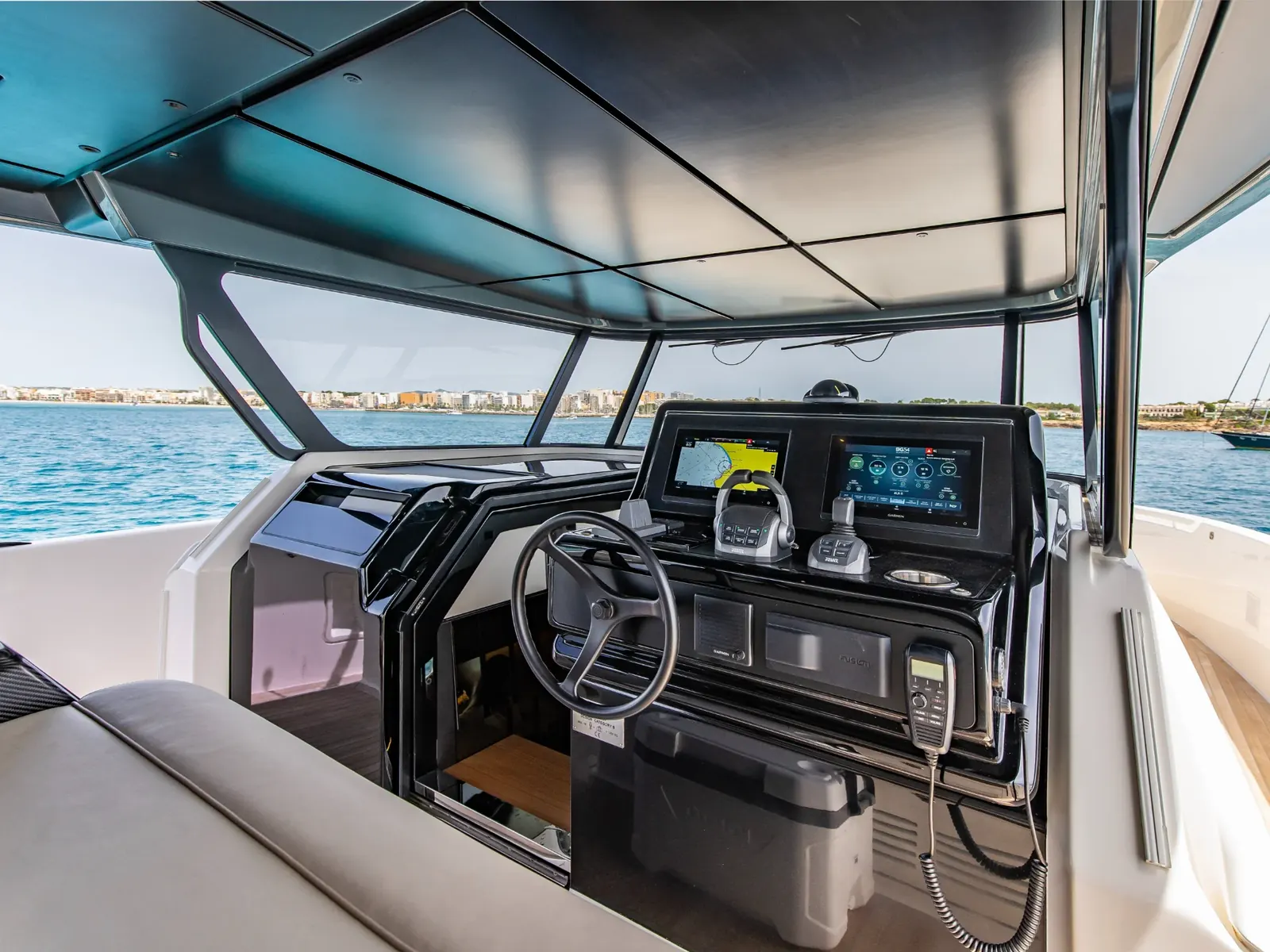
An engine alarm at sea rarely gives you much time to think, and the first few minutes decide whether it becomes a short delay or a long repair. This is the order we'd like a captain to work through before calling us. It applies to most diesel installations, whether the display says MTU, MAN, Caterpillar or Volvo Penta.
First: is anyone in danger?
Before anything technical, decide whether this is an emergency. Smoke from the engine room, a fire alarm, water rising in the bilge or a person hurt are not engine faults to diagnose. Deal with them first.
If lives are at risk, make a distress call on VHF channel 16, or press the red DISTRESS button on your DSC radio (channel 70), as Spain's maritime rescue service, Salvamento Marítimo, advises. From the shore the numbers are 112 or 900 202 202. A PAN-PAN call is the right one when the yacht is in difficulty but nobody is in immediate danger, for example when you've lost propulsion near a lee shore.
Minute 0 to 2: bring the load off and keep steerage
- Throttle back on the engine that alarmed. Most alarms are about heat or pressure, and load makes both worse.
- Keep control of the boat. On a twin-engine yacht you can usually carry on with the other engine. Check your sea room, traffic and depth before you look away from the helm.
- Don't reset and carry on at speed. A cleared alarm that comes back under load is giving you the same information twice.
The exception is low oil pressure. If the oil pressure alarm comes on and the gauge confirms it, stop that engine. A diesel can damage its bearings very quickly without oil pressure, and running it to "see what happens" is how a fault becomes an overhaul.
Minute 2 to 4: read and write down what the display says
Modern engines record far more than the alarm on the screen. Before anything is reset, note:
- the alarm text or fault code, exactly as shown;
- the time, the engine rpm and the speed when it happened;
- coolant temperature, oil pressure, exhaust temperature and boost, if your display shows them;
- whether the alarm was on one engine or both.
Take a photo of the screen. A fault code and the readings around it often tell an engineer more than a description of the noise.
Minute 4 to 7: look, don't touch hot parts
With the engine at idle or stopped, look over the side and into the engine room.
- Exhaust water. On a wet exhaust, check the outlet. Little or no water with a high temperature alarm points to the seawater side: a closed seacock, a blocked strainer or a failed impeller.
- Engine room. Look for smoke, steam, oil or coolant on the floor, a split hose, a loose belt, or a smell of hot rubber or burning.
- Bilge. Is the level normal? Is a bilge pump running more than usual?
- Never open a hot coolant cap. The system is under pressure, and coolant at working temperature causes serious burns.
Minute 7 to 10: the common alarms and the first check for each
| Alarm | What it usually means | First check |
|---|---|---|
| High coolant temperature | Not enough heat leaving the engine | Seawater flow at the exhaust, strainer, seacock open, coolant level once cool |
| Low oil pressure | Oil level, pump or sensor | Stop the engine, check the dipstick, look for leaks |
| High exhaust temperature | Poor seawater flow through the exhaust, or overload | Exhaust water flow, strainer, impeller, load |
| Water in fuel | Water in the fuel filter or separator | Drain the separator bowl, note how much water came out |
| Low coolant level | Leak or air in the system | Look for coolant on the floor or hoses, top up only once cool |
| Charging or battery | Alternator, belt or wiring | Belt tension and condition, battery voltage |
| Gearbox oil pressure or temperature | Gearbox oil level or cooler | Gearbox oil level, cooler seawater flow |
The table doesn't cover every engine. Your engine's manual and its own fault-code list take priority, because the same alarm text can mean different things on different control systems.
One thing catches many yachts in Mallorca: loose Posidonia leaves and plastic in the seawater strainers, especially after a night at anchor. If you clean a strainer, close the seacock first, and check the lid seal before reopening. A strainer lid that doesn't seal lets the pump draw air, which gives you the same alarm again.
Then decide: continue, anchor or call for help
Once you know what you're dealing with, there are three sensible choices:
- Continue on reduced power, usually on the good engine, to the nearest suitable harbour, watching the readings on the faulty one if it's still running at idle.
- Anchor and investigate, if you have sea room and safe holding. In the Balearics, choose sand rather than seagrass: Decree 25/2018 prohibits anchoring on Posidonia in Balearic waters, and the government publishes a meadow map.
- Ask for assistance or a tow, if you've lost both engines, the fault is getting worse or the conditions don't give you time.
What to send us
When you call or book, the things that let us arrive with the right parts are: the fault code and readings you noted, the photos, the engine make and model, and the yacht's position or berth. You can book a service online and upload the photos, and our AI technical intake will ask the follow-up questions while you're still on board. For anything urgent, call +34 971 251 374 or WhatsApp +34 674 427 692 at any hour. Our emergency response in Mallorca is within two hours.
Our emergency repairs page covers how call-outs work, and the main engine service page covers the scheduled work that prevents most of these alarms in the first place.