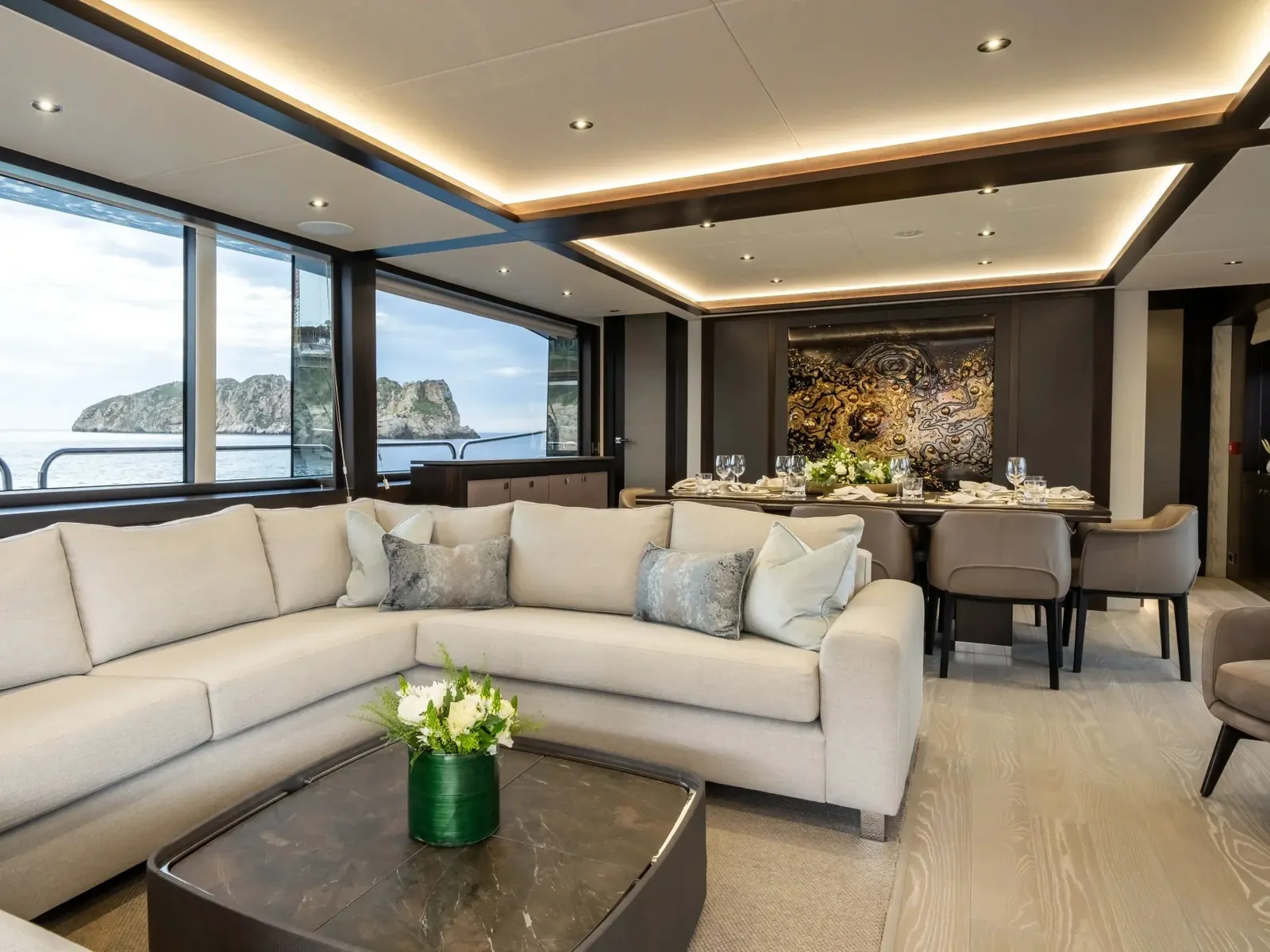
An interior refit can change more than the yacht's appearance. On a coded commercial yacht, the choice of upholstery, foam, curtains and bedding may be tied to the vessel's flag, code, tonnage and installed fire-protection systems.
The practical task is to establish those requirements before materials are ordered. This guide covers the relevant Red Ensign and MCA provisions, the evidence to retain, and the checks that should sit between selection, manufacture and fitting.
Establish the yacht's compliance basis first
Do not start with a fabric sample or a supplier's general description of a product. First identify the yacht's flag, commercial or private use, applicable code, tonnage and fire-system arrangement. These details determine which requirements and possible exceptions need to be checked.
The UK MCA states that REG Yacht Code Part A applies to commercial motor or sailing yachts of 24m load-line length and over, built on or after 1 January 2019, and carrying no more than 12 passengers. That scope should not be treated as a general rule for every yacht, so establish the vessel's actual status rather than selecting materials from the headline dimensions alone.
For Large Commercial Yacht Code vessels, the MCA guidance also distinguishes between vessels of 500GT and above and those below 500GT:
- 500GT and above: Accommodation spaces should have automatic sprinklers. Upholstery, bedding and suspended textiles are generally required to be inherently fire-retardant unless a fully addressable fire-detection system is fitted.
- Below 500GT: Upholstery and suspended textiles must be inherently fire-retardant unless the space has sprinklers or an equivalent approved fixed fire-extinguishing system.
These provisions make the installed fire system part of the interior specification. If the refit changes that system, or relies on it as the basis for accepting a material, refer the proposed arrangement through the yacht's compliance and flag-state support process before proceeding.
Match each interior item to its fire requirement
'Upholstery' is not one material for compliance purposes. Seating can include an upholstery composite and organic foam, while curtains are suspended textiles and mattresses fall within bedding components. Each category needs to be checked against the correct requirement and evidence.
For commercial yachts within the relevant Red Ensign Code scope, organic foams in upholstered furniture and mattresses must be combustion-modified to a recognised national or international standard. Suspended textiles such as curtains and drapes must be approved to FTP Code Annex 1 Part 7, unless the space has sprinklers or an equivalent fixed fire-extinguishing system.
The IMO 2010 FTP Code identifies Part 8 as the test for upholstered furniture. This includes an ignitability test for seating composites using smokers' materials. Part 9 is the test for bedding components.
| Interior item | Code or test point | Evidence to retain | Check before fitting |
|---|---|---|---|
| Organic foam | Combustion-modified to a recognised standard | Material approval or test evidence | Foam matches the approved schedule |
| Curtains and drapes | FTP Code Annex 1 Part 7, subject to the stated fixed-system exception | Approval evidence | Supplied textile matches the schedule |
| Upholstered furniture | FTP Code Part 8 covers upholstered furniture testing | Test or approval evidence | Seating composite matches the selected item |
| Bedding components | FTP Code Part 9 covers bedding testing | Test or approval evidence | Supplied bedding matches the schedule |
| Treated material | Accepted only through the relevant equivalence route | Provider certificate and declaration of conformity | Treatment and installed location are recorded |
A product description that uses general fire-safety language does not by itself establish that the material meets the yacht's applicable requirement. The documents must relate to the selected material, composite or treatment route, and the item delivered should match that evidence.
Treated fabrics need a controlled equivalence route
Fire-retardant treatment is not automatically interchangeable with an inherently fire-retardant material. MCA guidance says treatment can be accepted as an equivalent only when the administration is satisfied that the treatment process and its quality controls are equivalent to the appropriate FTP Code standards.
For UK or Red Ensign Group flag Large Commercial Yacht Code vessels, a service provider applying a qualifying fire-retardant treatment must be approved and certificated under the MCA procedures. A flame-retardant spray without the relevant process evidence, approval and certification does not establish this equivalence.
Where upholstery composites or suspended textiles do not meet the specified FTP standards, the Red Ensign Code provides an equivalent route. That route combines a fire-protection treatment process with the prescribed sprinkler, fixed-system or administration-accepted equivalence conditions. It should therefore be treated as a compliance decision, not as a workshop substitution made after the upholstery has been manufactured.
Before accepting treated material, request and review:
- Provider evidence: The approval and certificate relevant to the yacht's flag and code.
- Treatment record: The declaration of conformity for the completed treatment.
- Material identification: A clear link between the declaration, the treated material and the installed item.
- Location record: The cabin or accommodation space where the item is fitted.
- Fire-system basis: The sprinkler, fixed-system or accepted equivalence condition on which the arrangement depends.
Build documentation into the refit sequence
The safest point to resolve fire-performance evidence is before ordering. Once the yacht's compliance basis is known, create a material schedule covering foam, upholstery, loose upholstered items, curtains, drapes, mattresses and other bedding included in the project.
Use clear hold points rather than relying on a final inspection:
- Define the vessel basis. Record flag, use, code, tonnage and fire-system arrangement.
- Classify each item. Separate suspended textiles, seating composites, organic foam and bedding components.
- Review the evidence. Check the relevant FTP report, approval evidence or accepted treatment documentation before authorising the order.
- Record the selected product. Tie each material and composite to its intended location.
- Check the delivery. Compare curtains, loose upholstered items and bedding with the approved material schedule before fitting.
- File the final documents. Keep reports, approvals, certificates and declarations against the installed item and location.
MCA guidance says treatment declarations of conformity may be reviewed during vessel surveys and inspections. Documentation is therefore part of the completed refit, not an optional supplier file. A wider interior project can be coordinated through yacht refit management so that material approval and fitting hold points remain visible within the work sequence.
What crew can check safely
Crew can control the material schedule and documentation without making technical judgements about approval equivalence. The key is to identify discrepancies before installation and refer them rather than accepting a verbal assurance.
- Confirm the vessel details: Record the yacht's flag, code, tonnage and fire-system arrangement before fabrics, foam, curtains, upholstery or bedding are ordered.
- Collect supporting documents: Obtain the relevant FTP test reports and material approval evidence. Where treatment is used, collect the provider certificate and declaration of conformity.
- Link evidence to the installation: File each document against the location and item installed, rather than keeping an unreferenced collection of certificates.
- Check delivered items: Compare curtains, loose upholstered items and bedding with the approved material schedule before fitting begins.
- Report fire-system changes: Escalate any alteration to sprinklers or an equivalent fixed fire-extinguishing system where that system forms the basis of an interior material equivalence.
Crew should not approve a replacement merely because its colour and appearance match. If its fire-test, approval or treatment evidence differs from the scheduled material, stop the fitting decision and request a technical review.
When to call an engineer
Bring in an engineer or compliance specialist when the refit crosses from material selection into the yacht's surveyed fire-safety arrangement. This applies even when the physical upholstery work appears straightforward.
Call for technical support when:
- The yacht is commercially coded or surveyed: The project is subject to class or flag review, or the chosen fabric or foam lacks the required fire-test or treatment evidence.
- The refit affects another system: Interior changes alter sprinklers, fire detection, escape routes, ventilation, insulation or electrical wiring.
- Treatment evidence is incomplete: The proposed provider cannot supply the approval, certificate or declaration of conformity relevant to the yacht's flag and code.
- An exception is being relied upon: The proposed material depends on sprinklers, an equivalent fixed fire-extinguishing system or another administration-accepted equivalence condition.
Do not let manufacture or fitting run ahead while one of these points remains unresolved. The engineer needs the vessel details, material schedule, proposed installation locations and available approval documents to assess the issue against the correct basis.
Blueward Marine in Palma provides yacht upholstery and canvas services, and a service request can be submitted through the online technical booking form with photos and project details. For urgent assistance in Mallorca, the 24/7 line is +34 971 251 374.
Frequently asked questions
Does every yacht need IMO fire-rated upholstery?
No single rule applies to every yacht. The requirement depends on the vessel's flag, use, code, tonnage and fire-protection arrangement. MCA guidance for Large Commercial Yacht Code vessels sets requirements for upholstery and textiles, with different conditions for vessels of 500GT and above and those below 500GT.
What is IMO FTP Code Part 8 for yacht interiors?
The IMO 2010 FTP Code identifies Part 8 as the test for upholstered furniture. It includes an ignitability test for seating composites using smokers' materials. The material and composite installed during a refit should match the test or approval evidence retained for that item.
What documents should be kept after an upholstery refit?
Keep the relevant FTP test reports, material approval evidence and the approved material schedule. If fire-retardant treatment is used, retain the provider's certificate and declaration of conformity. File each document against the item and installation location, as MCA guidance says treatment declarations may be reviewed during surveys and inspections.
Sources and further reading
These references informed this guide. Follow the procedures and limits for the equipment installed on board.