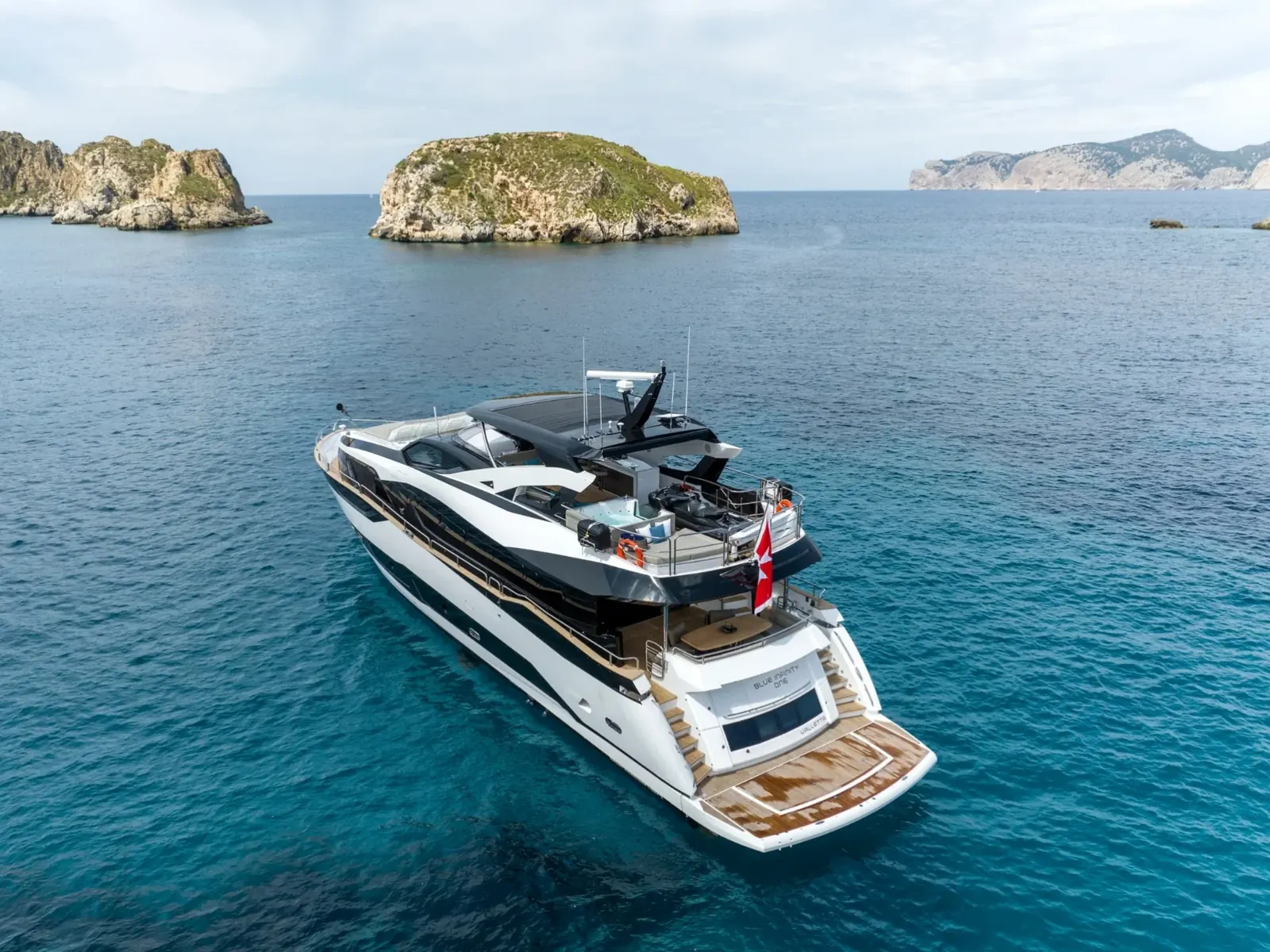
Ask guests what they remember about a week in the Balearics, and a rolling night at anchor will be on the list for some of them. Plenty of the island's best anchorages are open to swell from at least one direction, and the afternoon sea breeze (the embat) can set up a beam swell that keeps the yacht moving well into the evening.
Zero-speed stabilisers are what make those anchorages comfortable. They're also a system that's easy to forget until it stops working.
Underway versus zero speed
Underway, a stabiliser fin works like a small wing. The yacht's forward speed creates flow over the fin, and by changing its angle the control system generates lift up or down to counter the roll. It needs relatively little force because the water is already moving.
At anchor there's no forward speed and so no flow to use. A zero-speed system gets its force differently: it sweeps the fin quickly through the water, like a paddle, and the reaction from pushing that water opposes the roll. It takes more power, faster movement and fins designed for the job, which is why zero-speed capability is usually specified with the system rather than added later.
Some manufacturers have shaped their fins for this. Sleipner's curved Vector Fins, for example, are designed to perform at anchor as well as underway.
Hydraulic and electric systems
Hydraulic systems have been the standard for decades. Each fin is moved by hydraulic cylinders or a rotary actuator, supplied by a power pack. Underway, the pump is often driven by a main engine. At anchor, an electric pump takes over, which means the generator has to be running and has to have the capacity. ABT-TRAC and Naiad Dynamics both make well-established hydraulic systems, including zero-speed.
Electric systems move the fin with an electric motor and drive, without hydraulic oil. They draw power from the yacht's electrical system and have fewer components that can leak. CMC Marine's electric fin stabilisers are a leading example, and Sleipner and ABT-TRAC also make electric systems.
Both need a good control system: motion sensors that measure roll, and a controller that works out how each fin should move, many times a second.
What usually goes wrong
- Fins won't centre or the system won't switch on. A sensor or control fault, low hydraulic pressure, or a problem with a fin's position feedback.
- Oil temperature alarms on hydraulic systems. Reduced seawater flow through the oil cooler, low oil level, or a component working harder than it should.
- Knocking from the fin area. Wear in bearings or actuator joints, or play in the fin shaft.
- Oil near a fin or in the bilge by an actuator. A seal or hose is leaking.
- Zero-speed won't engage. On hydraulic systems, often the electric pump or its power supply. Otherwise a control interlock.
- Less roll reduction than before. Calibration or gain settings, low pressure, or fins that are fouled or damaged.
Looking after them
Always follow the manufacturer's maintenance schedule, which is usually based on running hours and time. In practice, care falls into three layers.
Day to day (crew)
- Look around the actuators and in the bilge near each fin for oil.
- Note any alarm messages, even ones that clear themselves.
- Listen for new noises when the system is running.
Each season
- Hydraulic oil and filters, to the manufacturer's intervals.
- Clean the seawater side of the oil cooler, the same as any other seawater-cooled system.
- Check accumulators where fitted.
- Run the self-test and review the fault log with a technician.
At haul-out
- Inspect the fins for damage and fouling, and check shaft play.
- Inspect or renew fin shaft seals and bearings.
- Antifoul the fins along with the hull, following the manufacturer's guidance.
Seal and bearing work normally needs the yacht out of the water, so it pays to plan it alongside antifouling and any other underwater jobs, and lift only once.
One last tip
If you spend most of your time at anchor, zero-speed performance matters more than underway performance. Check the zero-speed side before the season: the electric pump on a hydraulic system and its power supply, or the drives on an electric one. And make sure the generator can carry the stabilisers together with the air conditioning on a hot afternoon.
We service Naiad Dynamics, CMC Marine, ABT-TRAC and Sleipner stabilisers, hydraulic and electric, across Mallorca and the Balearics. See our stabiliser service page or book online.